Stop Blaming God: It’s Not His Fault

Have you ever caught yourself thinking — or maybe even saying out loud —

“Why did God give me this [disease, pain, hardship, grief, addiction]?”

“If God really loved me, He wouldn’t make me this way.”

“I can handle this. It’s really not that bad.”

If any of those sound familiar, you are not alone. And I want to tell you something that might sting a little before it sets you free: if you are blaming God for your addiction, your struggle, your craving — you are doing exactly what Satan wants you to do.

The good news is, God is not only bigger than Satans lies, He’s sovereign over ALL of your circumstances.

The Blame Game Is Older Than You Think

The blame game isn’t a modern problem. It’s literally the oldest story in the Bible.

Genesis 3. The garden. God gave Adam and Eve everything — with one boundary. And when the serpent showed up and they broke it, look at what happened. God asked Adam, “Did you eat from the tree I told you not to eat from?”

Adam’s response? “The woman you put here with me — she gave me some fruit from the tree, and I ate it.” (Genesis 3:12 NIV)

He didn’t just blame Eve. He blamed God. The woman YOU put here.

That same ancient pattern runs in us today. When life is a mess, when we feel enslaved to something we can’t shake, our first instinct is to look up and ask, “God — how could You let this happen to me?”

The Lie That Keeps You Trapped

Here’s what God’s Word actually says about where temptation comes from:

“When tempted, no one should say, ‘God is tempting me.’ For God cannot be tempted by evil, nor does he tempt anyone.” — James 1:13 NIV

God did not give you your addiction. Not the substance addiction. Not the approval addiction. Not the shopping or scrolling or food or work addiction. Not one of them.

And that quiet lie — “I can control it, it’s not that bad” — is one of the most dangerous of all, because it cuts off the only lifeline that actually works. Jesus said plainly in John 15:5, “Apart from me you can do nothing.” That’s not a criticism. That’s an invitation.

So Who Is Actually to Blame?

John 10:10 answers this better than I ever could:

“The thief comes only to steal and kill and destroy; I have come that they may have life, and have it to the full.”

There is a thief. There is a killer. There is a destroyer. And it is not God.

Ephesians 6:12 reminds us that our real battle isn’t against flesh and blood — it’s against spiritual forces of darkness. We have a real enemy, and when we blame God, we let that enemy off the hook entirely while pushing away the only One who has the power to set us free.

God Allows Hard Things — But He Doesn’t Waste Them

Here’s the part I want to be careful with, because I know some of you are carrying real pain — things that were done to you, not chosen by you.

God is not the author of your addiction or your trauma. But He is a Redeemer, and Romans 8:28 promises that “in all things God works for the good of those who love him.” Not that all things are good — but that God works in all of it.

I’ve seen this in the jail cells where I mentor women. God didn’t put those women there. But He showed up there anyway.

The Power You Have Access To Right Now

When you stop blaming God and run to Him, you get access to something no one else can offer: the Father who is completely for you (Romans 8:31), the Son who is actively interceding for you (Hebrews 7:25), and the Holy Spirit who counsels, guides, and gives you discernment in your weakest moments (John 14:26).

“My grace is sufficient for you, for my power is made perfect in weakness.” — 2 Corinthians 12:9 NIV

And the verse I want you to write somewhere you’ll see it every single day:

“With man this is impossible, but not with God; all things are possible with God.” — Mark 10:27 NIV

One Practical Step for This Week

When a lie about God surfaces — and it will — ask yourself one question: Does this align with who God says He is in Scripture?

Then speak the truth out loud. Replace the lie with a verse. Faith comes from hearing (Romans 10:17), and there is something powerful about saying truth into the air in your own voice.

The battle is already won. You just have to stop fighting on the wrong side.

Stop blaming God. Start running to Him. He is not the source of your captivity — He is the only source of your freedom.

Want to go deeper? Listen to the full episode on the Addicted to God Podcast — available on Spotify, Apple Podcasts, and YouTube. Search “Addicted to God.” A new episode is published weekly.

Photo by Nicolu00e1s Langellotti on Pexels.com

When Church Hurts: Healing Your Way Back to God

If you’re carrying wounds from church hurt or spiritual disappointment, I want you to know you are seen. God sees you and no one knows your pain more than Jesus.

Whether you’ve been gossiped about, excluded, judged harshly, or feel like you can’t show up as your real, struggling self – I know that pain cuts deep. Some of the hardest stories I’ve walked through with women involve betrayal by pastors or leaders — situations involving abuse of power, violation, or shattered trust. No matter what level of hurt you carry, I want to gently walk with you through three important truths:
1. Who God is and what He intended His church to be;
2. Why the church is capable of disappointing us,
3. How we can move forward from these hurts in the only non-regrettable way.

Who God is and what He intended His church to be

God is perfect love. As 1 John 4:8 tells us, “God is love.” He is safe, kind, and faithful even when everyone else fails. Lamentations 3:22-23 reminds us, “Because of the Lord’s great love we are not consumed, for His compassions never fail. They are new every morning; great is Your faithfulness.”

From the beginning, God designed the church to be a family — a place of healing, truth, love, encouragement, and safety. Ephesians 2:19 says, “You are no longer foreigners and strangers, but fellow citizens with God’s people and also members of His household.” He wants us to belong, to be known, to grow together, and to reflect Jesus to a hurting world. The Bible calls the church the Body of Christ (1 Corinthians 12:27) and the Bride of Christ (Ephesians 5:25-27). It was never meant to wound us. It was meant to help us become more like Jesus.

Why the church is capable of disappointing us

Here’s the honest part: the church is made up of imperfect, broken people — just like you and me. We’re all still being sanctified. Romans 3:23 says, “For all have sinned and fall short of the glory of God,” and 1 John 1:8 reminds us that if we claim to be without sin, we deceive ourselves.

In my own story, I grew up in what I’ll call “Judgment Church.” My parents openly expressed frustration with the deacons who were voted in, and the word “hypocrite” was thrown around often. In my formative years, that left a deep impression. The church talked about living by Christian standards, but the infighting, gossip, and disunity hung like a gray cloud over everything. It made me question if any of it was real.

This kind of pain is especially confusing because we expect God’s people to be safe. When they’re not, it can shake our trust in God Himself. But here’s the good news: God sees every wound. He understands the betrayal. And He still wants to heal you so you can keep moving toward Him.

Jesus knows this pain intimately. He was betrayed by His own inner circle. David was chased by the people who should have protected him. The Bible never hides the failures of God’s people — yet it still calls the church family.

How we can move forward from the hurts we’re carrying

So how do we move forward in the only non-regrettable way?

First, we separate God from His imperfect people. God is not like the ones who hurt you. He is safe. He is trustworthy. He will never misuse you. Psalm 27:10 promises, “Though my father and mother forsake me, the Lord will receive me.”
That includes spiritual family too.

Second, we name the pain honestly to God and to safe people — without shame. Psalm 147:3 says, “He heals the brokenhearted and binds up their wounds.”

Third, we entrust every hurt to the Righteous Judge, just like Jesus did. 1 Peter 2:23 tells us, “When they hurled their insults at him, he did not retaliate… Instead, he entrusted himself to him who judges justly.”

And fourth, we begin to re-engage with wisdom. Healthy community is still God’s design. Hebrews 10:24-25 encourages us, “And let us consider how we may spur one another on toward love and good deeds, not giving up meeting together…” Even if it looks different for a season, this space — GodlyGirlfriends and The Addicted to God Podcast — can be part of your healing as you rebuild trust. I recommend listening to Episode 4 that describes how to find a healthy church. Unfortunately, not all churches are healthy – like the one I grew up in.

A Prayer for Healing

Lord, the wounds from people have hurt me deeply. I bring every betrayal, every silence, every judgment, every abuse, and any shame to You. Help me separate You from the failures of others. Heal my distrust. Restore my hope in healthy community. Whether in a group or a local church, show me where I can safely belong again. I entrust every hurt to You, the Righteous Judge. In Jesus’ name, Amen.

Safe Community Inventory Take a few quiet minutes with your journal:

  1. Name the Hurt: Briefly describe one experience of church hurt or spiritual disappointment — or even just feeling ashamed to show up as you really are.
  2. Separate the Lies from Truth: Write: “Because of this, I believed ___ about God, church, or people. But God says ___” (let the Scriptures speak to you).
  3. My Next Step: Choose one small, safe step toward community this week.
  4. Affirmation: Write and speak out loud: “God receives me even when people don’t. I am not defined by how the church treated me.”

I would love to hear how this message, podcast, or prayer has helped you. Please comment or email me at addictedtogodpod@gmail.com.

Uprooting Bitterness

Hello, sweet friend. If resentment has been quietly weighing on your heart, you’re not alone. Bitterness slips in after real hurt—betrayal, abandonment, or injustice—and slowly poisons our joy, relationships, and walk with the Lord.

As host of The Addicted to God Podcast, I created this space for women who feel tired, overwhelmed, or discouraged yet long for a deep, lasting relationship with God. The movement was born in a local jail where I’ve mentored women for over ten years.

Many came carrying destructive addictions that stole their freedom, families, and hope. The ones who found true transformation didn’t just try harder to quit. They transferred their addiction—shifting that intense drive into a lifelong pursuit of God and His Word.

That’s the heart of this podcast and the Addicted to God movement. In a recent episode, we tackled bitterness, often called “the Prison of Fairness.” How Bitterness Takes Root. It usually begins with a legitimate wound. Someone was unfair, unkind, or unfaithful, and your heart cries, “That’s not fair!” Our instinct is to demand repayment.

But holding onto that debt chains us to the person who hurt us. We replay the offense like a courtroom drama, exhausted as judge, jury, and victim.The women I mentor often say, “They never apologized.” Yet carrying that unpaid debt keeps us locked in the past.

Hebrews 12:15 (NIV) warns: “See to it that no one falls short of the grace of God and that no bitter root grows up to cause trouble and defile many.” That root chokes peace and hardens hearts. The Radical Cure: Forgiveness.

Forgiveness isn’t pretending the pain didn’t happen or saying it was “okay.” It’s a legal transfer: we place the debt in God’s hands and say, “Lord, You are the Righteous Judge. I trust You.”

Jesus modeled this on the cross: “Father, forgive them, for they do not know what they are doing” (Luke 23:34 NIV).

Ephesians 4:31-32 (NIV) commands: “Get rid of all bitterness… forgiving each other, just as in Christ God forgave you.”

We’ve been forgiven an unpayable debt. That same grace empowers us to release others. You don’t need an apology that may never come—you’re setting yourself free from the cage.

Signs that bitterness has taken root is under the surface. Hurt is normal; bitterness is when hurt becomes a permanent heart posture. Signs include replaying conversations, sarcastic humor, avoidance, jealousy, feeling distant from God, irritability, or struggling with gratitude.

Here is a quick test:

Does someone’s name tighten your stomach or drain your joy?

I have a personal confession. While I was preparing this teaching, a name surfaced in my heart. Until then, I didn’t realize that I was harboring bitterness over a faded friendship. A friendship that had evolved, where I most recently felt excluded. I confessed my people-pleasing and seeking her validation instead of God’s. God lovingly redirected my bitter thoughts and replaced them with a heart of gratitude for the authentic Godly girlfriends that I now have in my life and who hold me accountable – accountable to living the Godly life I aspire to live. This is why I started GodlyGirlfriends.com—to build a community where women support and grow together in faith.

So I leave you with a practical exercise. I call it “The Debt Ledger”.

Try this simple exercise with God:

  1. Identify your Debtor — Write the name that triggers tightness.
  2. Itemize the Debt — Honestly list what was taken (trust, peace, reputation, etc.).
  3. Trace the Poison — Note how it has affected your life.
  4. Transfer the Title — Cross it out and pray: “Lord, I release my right to collect. I transfer this debt to You. Heal my heart. In Jesus’ name.”

Forgiveness is a process. When memories return, remind yourself: the debt has been transferred.

Romans 12:19 (NIV) reminds us: “It is mine to avenge; I will repay,” says the Lord. Also, “Fix Your Eyes on Jesus.” Jesus endured the ultimate injustice on the cross without bitterness (Hebrews 12:2). He overcame for us.

Today, transfer your hurts to Him. This is part of being Addicted to God—loving the Lord with all our heart, soul, mind, and strength (Mark 12:28-31) and if this spoke to you, share it with someone carrying bitterness. You are not defined by your past and God is bigger than any struggle.

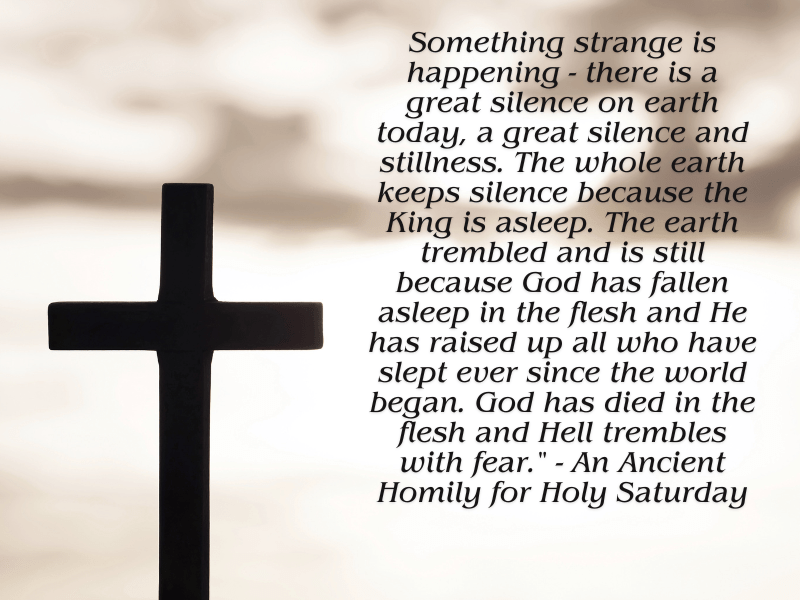
Saddest, Darkest, Saturday

Can you imagine the confusion? Imagine how discouraged they must have been. Imagine the grief – the one they put all of their hope is gone. Dead. All the hope of what (they thought) Jesus was supposed to be and what Jesus was supposed to do is gone. What now? Yesterday he died, tomorrow he will be resurrected – but they don’t know that. This is a dark day. Probably the worst day of their lives.

Are they replaying all the words that Jesus spoke to them? He was very explicit about what he would endure. At the time, they rebuked him for saying those things. He was supposed to conquer the world, not be crucified by it.

Were they trying to move ahead and go back to a “normal life”? What is a “normal life” anyway? All they had known for 3 years was Jesus. They gave up EVERYTHING to follow him. Did they have regrets? Were they questioning their decision to follow him now? He said he was the son of man and he called himself son of God – but if that were true, then how could he die? How could this be?

We celebrate Good Friday and we praise and worship God for Sunday, but what about Saturday? When we put ourselves in the disciples shoes, this must have been the greatest test of their faith. I can only imagine how I would have felt. Thank God Sunday is coming, just as we thank God for sending Jesus into the world to die for our sins. Without this sacrificial act, humanity truly would be hopeless.

Why Is The Bible So Confusing?

If you’ve ever picked up the Bible and thought, “This feels like a foreign language to me,” you are not alone. Maybe you’ve tried reading it and felt confused, bored, or even a little ashamed because it just doesn’t make sense. Or maybe you long for a real relationship with God but don’t know where to start.

I completely understand – I hear this often from women I mentor. It is important to consider that the Bible was written in a completely different time and world than ours. The people who wrote it didn’t have phones, cars, or the internet. They spoke different languages, lived in different cultures, and told stories in ways that don’t always sound like our quick modern self-help books.

Sometimes the words just feel old, making a verse feel irrelevant, antiquated, or out of date. But here’s something important the Bible itself explains:

In 1 Corinthians 2:14 (NLT) it says, “People who aren’t spiritual can’t receive these truths from God’s Spirit. It all sounds foolish to them and they can’t understand it, for only those who are spiritual can understand what the Spirit means.”

In 2 Corinthians 4:3-4 (NLT) we read, “If the Good News we preach is hidden behind a veil, it is hidden only from people who are perishing. Satan, who is the god of this world, has blinded the minds of those who don’t believe. They are unable to see the glorious light of the Good News.”

If the words feel veiled or confusing right now, it might not only be the language or the history — there can be a spiritual side too. Our wounds, weights, and old ways can keep our hearts a little closed off… until we gently invite the Holy Spirit to help us see.

Here’s the good news: You don’t have to stay stuck there. The same Jesus who rose from the dead is ready to come into your life right now. If you’ve never invited Him in, or if you want to open your heart fresh today, you can simply pray something like this from your heart:

“Jesus, I believe You are the Son of God who died for me and rose again. I’m tired of carrying these wounds, weights, and old ways on my own. Please forgive me, come into my life, and fill me with Your Holy Spirit. Help me understand Your Word and become truly addicted to You. Amen”

The moment you invite Him, the Holy Spirit begins to lift the veil and open your eyes to the beauty of God’s Word. It’s the beginning of the most life-giving relationship you’ll ever have.

Don’t lose hope! The very same Bible that can feel foreign at first is actually the most powerful, life-giving book in the world. Read Psalm 19:7-14 (NLT) and see how God describes His Word. He says it revives us, makes us wise, brings joy, and gives insight for living. That’s powerful – and worth the pursuit.

Proverbs 30:5-6 (NLT) reminds us: “Every word of God proves true. He is a shield to all who come to him for protection. Do not add to his words, or he may rebuke you and expose you as a liar.”

Even when it feels hard to understand at first, every word is true and protective. God wants to use His Word to heal your wounds, lift your weights, and change your ways — so you can transfer all of that to the one healthy addiction that truly satisfies: Him.

You’re not defective if the Bible feels confusing right now. It simply means you’re human and you’re stepping into something divine. God didn’t give us a cold checklist — He gave us stories, songs, letters, and real-life truths so we could truly know Him. It’s a lot like beginning any new relationship. At first it feels awkward, but the more time you spend, the more comfortable it becomes — especially as the Holy Spirit softens your heart.

Here are a few gentle, practical steps you can try this week:

  • Use an easy-to-read translation like the New Living Translation (NLT). Pair it with the YouVersion Bible app and listen to the chapter read aloud — it helps the words come alive without getting stuck on hard pronunciations.
  • Don’t start at the beginning. Begin with the story of Jesus in the book of John or Mark.
  • Pray before you read: “God, I don’t understand this very well, but I want to know You. Holy Spirit, please open my eyes and my heart.”
  • Keep it short and kind to yourself — just 10 minutes a day is better than forcing more when you feel overwhelmed.
  • Don’t go it alone. Talk with friends, join a Bible study, or watch short Bible Project videos on YouTube to understand the big picture.

When my days were packed with corporate work, raising my daughters, and earning my master’s degree, I had to schedule time with God like any important appointment. That small shift changed everything for me. I realized that if I wouldn’t skip meetings or time with my girls, how much more important was my time with Him?

Read just one chapter a day, or even just a short section within those books. If you have a study Bible – read the footnotes and gain a deeper, more applicable understanding. Don’t forget to pray first. If something confuses you, that’s okay — just keep showing up anyway.

You’ve got this my friend. The Bible isn’t meant to stay confusing forever. It’s meant to become the most life-changing voice in your story — the place where you meet with God Himself and discover real freedom from the wounds, weights, and ways that have held you back.